What temperature should you brew tea at, and what is the best temperature to drink it?
Different teas need different water temperatures
Research by the Tea and Beverage Research Station shows that brewing temperature affects the quality of the liquor in various ways.
Caffeine, total and individual catechins, and total free amino acids all increase as the brewing temperature rises.
https://www.tres.gov.tw/ws.php?id=3831
Water temperature matters just as much for bringing out a tea's character,
and because teas differ in how far they are oxidised, they need different temperatures.
A comparison across 80°C, 90°C and boiling water is shown below:
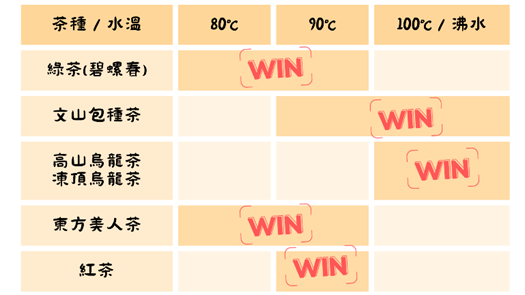
On sensory evaluation, across the three brewing temperatures:
- Green tea (Biluochun) was better at 80-90°C than at boiling,
Wenshan Baozhong was better from 90°C to boiling than at 80°C,
high mountain tea and Dong Ding oolong were best brewed with boiling water,
Oriental Beauty was better at 80-90°C than at boiling,
and black tea was better from 90°C to boiling than at 80°C.
How temperature relates to the quality of the liquor
Different water temperatures change the colour, aroma and flavour of the tea, and change what is extracted from the leaf.
Too hot and too much is extracted, so bitterness comes forward;
too cool and the leaf does not give up enough, so the flavour is thin.
Brewing temperature for green tea
Brewing green tea with water that is too hot (above 90°C) dulls the liveliness the liquor should have.
Brewing temperature for high mountain tea and Dong Ding oolong
Brewing oolong with water that is too cool (below 90°C) leaves the aroma flat, without the assertive character and depth of finish an oolong should have.
Rate and speed of extraction
The hotter the water, the higher the rate and the faster the extraction; cooler water does the opposite.
This is what governs the strength of the liquor: with the same ratio of leaf to water, hotter water reaches the strength you want sooner, cooler water takes longer.
Controlling bitterness
Hotter water brings bitterness forward;
cooler water holds it back.
So if a tea is too bitter, lower the temperature - and shorten the steeping time as well.
An easier way to heat the water
Modern life moves quickly and brewing has become much simpler, with many people using an electric kettle.
So how do you hit the right temperature for each tea with a kettle?
Once the kettle has boiled:
going from 100°C down to 95°C takes roughly 1-2 minutes.
From 95°C down to 90°C takes roughly 2-4 minutes.
From 90°C down to 80°C takes roughly 5-7 minutes.
Altitude and air temperature will shift these times somewhat.
What is the best temperature to drink tea at?
"Caution: hot" appears on a great deal of food packaging, and there is a reason for that.
A claim has circulated online that drinking tea at 70°C increases the risk of oesophageal cancer eightfold: https://heho.com.tw/archives/29467
At first glance it looks as though hot tea raises that risk.
Read the underlying material carefully, though, and the factor at issue is heat - a temperature that is too high - not tea itself. Tea is innocent here.
Health Promotion Administration (news feature, 2022/11/10):
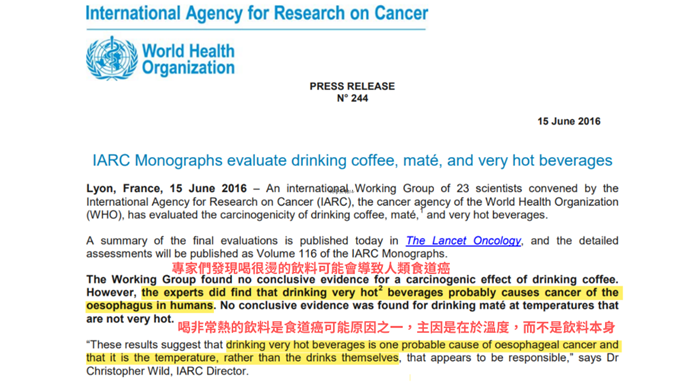
The World Health Organization classifies drinks above 65°C as a probable carcinogenic factor for oesophageal cancer. If food feels scalding, it may well be hot enough to damage the oesophagus, so please check the temperature before putting food in your mouth, or let it cool a little first.
The WHO material on this is here:
https://www.iarc.who.int/wp-content/uploads/2018/07/pr244_E.pdf
The experts "found that drinking very hot beverages probably causes cancer of the oesophagus in humans".
The point is the very hot temperature, not the drink itself.
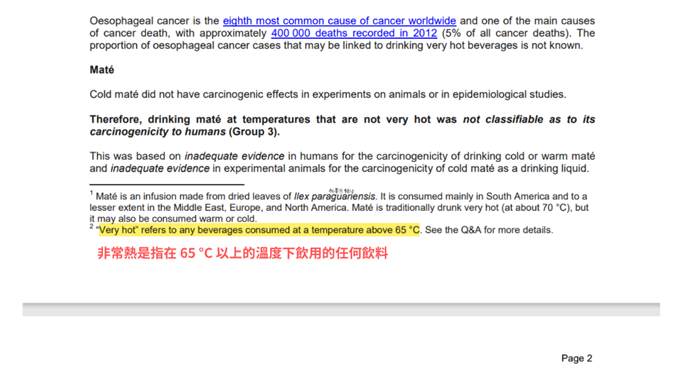
So what counts as very hot? It means above 65°C.
Note 2 of the same document is explicit: "very hot" refers to any beverage drunk at above 65°C.
What matters is repeated exposure to high heat over time
Drinking anything above 65°C may irritate the lining of the oesophagus,
and repeated irritation over a long period may lead to changes in that lining and, in time, to cancer.
So the risk lies in long-term exposure to high heat, not in the drink itself.
Saying "drinks above 65°C cause cancer" therefore overstates it.
As long as it is not scalding, it is fine.
Tasting tea should be a pleasure
There is a Taiwanese saying, "siau-kiann-tua-tshui".
It carries two meanings, one of which is
"with something hot, the worst thing is to swallow it in one go - you will be badly hurt."
Which chimes rather well with not drinking things too hot.
Tea needs water of at least 80°C to brew (the exact temperature depends on the type)
and while you wait for the leaves to open, the temperature falls of its own accord.
In the meantime, notice the aromatics the leaf gives up
as they drift off with the steam.
Notice how different teas shift:
flowers, sweetness, beans, cut grass, seaweed...
and from your own experience, from the library of smells in your head,
look for something similar, and connect, compare, remember.
Wait until the liquor is no longer scalding,
then taste it slowly,
building up your own tasting library one cup at a time.
As long as it never gets hot enough to hurt your throat, you can drink it with confidence
Leon
Hi! I'm Leon. We invite you to join us on the journey to safeguard the flavour of traditional charcoal roasting.